Keeping Bad News From Getting Worse: Lessons From Microsoft
IBM CEO Arvind Krishna offers an example many chief executives should follow
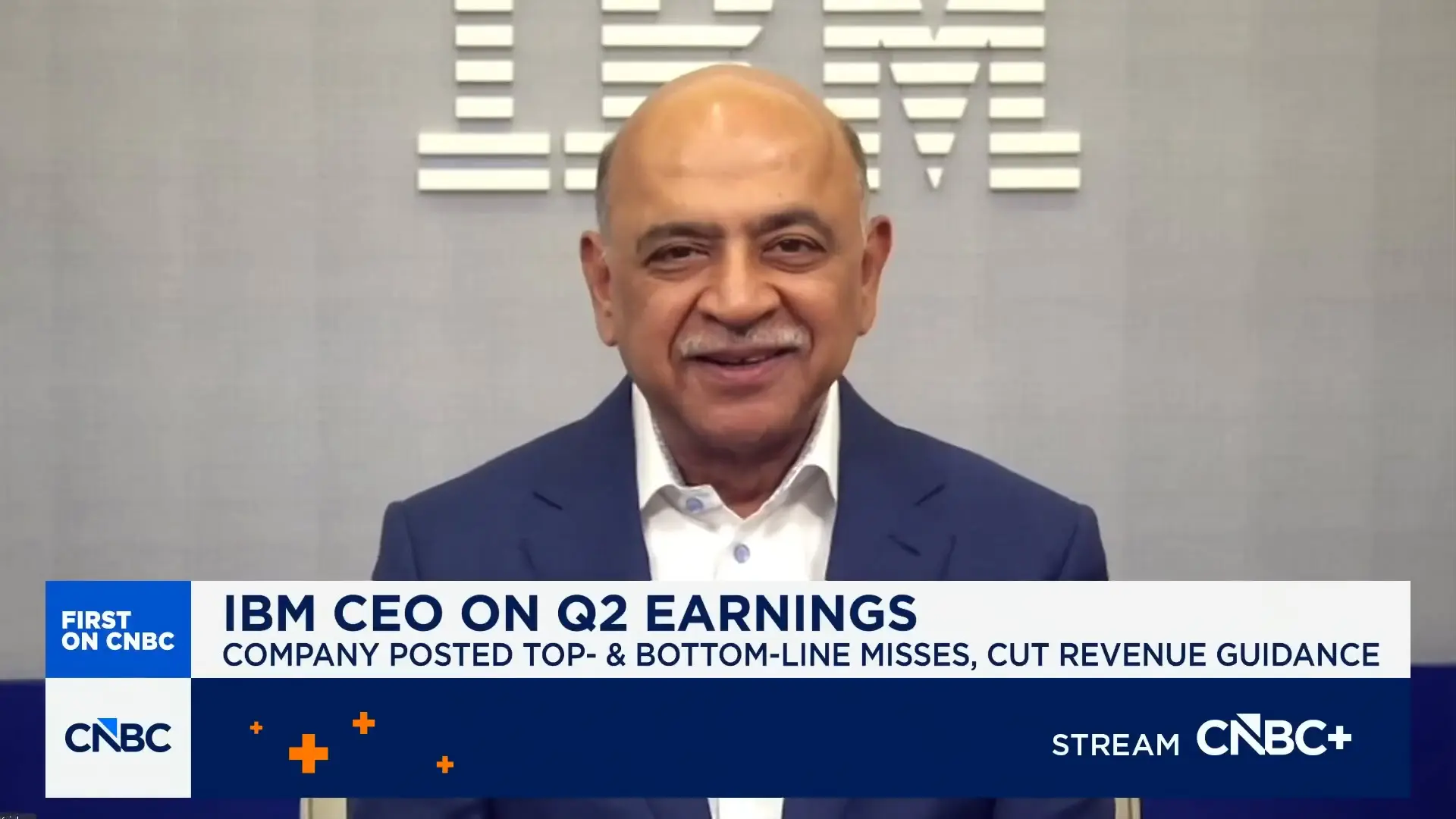
It isn’t often that you can say that a CEO did a good job on a day when the company stock price plunges 25%, but that’s the case this month with Arvind Krishna of IBM.
Investors in Big Blue suffered the biggest share price drop in the company’s history on July 14, 2026, after the tech giant unexpectedly announced a sharp slowdown in sales in the second quarter, which ended June 30.
The sudden sales slump struck a nerve. Investors were already worried that customers would buy artificial intelligence programs instead of IBM’s heavy-duty business software and mainframe computers. The Armonk, New York-based company isn’t the only tech company subject to these fears.
It might have been worse, but Krishna, who is chairman as well as chief executive, accompanied the announcement with a letter to investors that explained the shortfall and didn’t make excuses.
“We did not adapt and move quickly enough,” Krishna wrote, nine days before IBM was scheduled to release its second-quarter earnings.
The episode is a reminder of an important rule for corporate communications: Don’t sit on news, especially bad news. And Krishna’s letter isn’t perfect, but it is forthright and an example of how CEOs also should address bad news.
Get out news
Publicly held companies typically don’t announce important financial information during a “quiet period,” which stretches from the last several weeks of a quarter until a company announces financial results for that quarter.
At International Business Machines, the board debated whether to hold the bad news or wait until July 22, when the company had scheduled the release of its second-quarter earnings, The Wall Street Journal reported after the surprise warning.
“The board agreed to take its medicine and disclose the disappointing results in the hopes of winning credibility for transparency,” the Journal said.
IBM is closely covered by many media outlets, one of which could have broken the news of slowing sales. Such a story wouldn’t have had the details that IBM provided, and it would have lost the company the opportunity to shape the narrative.
The late Chicago PR expert Kathleen Connelly had a simple formula for crisis communications: “Tell it all, tell it accurately and tell it fast.”
IBM moved fast, but the candor of Krishna’s letter was key.
The letter
The understated headline is: “Arvind Krishna’s Letter to IBM Investors.”
Instead of a press release format, the filing started this way:
“IBM Investors –
“This morning we are releasing selected preliminary second-quarter 2026 financial results. We are still working to close our financial reporting for the quarter and our final results could be slightly different.”
This begins the conversational tone for the piece. In light of the seriousness of the news, “Dear IBM Investors,” would have been too informal.
Krishna could have started memo style, with “To the Shareholders of IBM.” That’s how Warren Buffett began his renowned annual letters. But that would have been too formal. Krishna’s dash is more casual than the colon that Buffett preferred.
After this introduction, Krishna starts with the bad news: A series of bullets that summarize the slumping preliminary second-quarter results for revenue, profit, cash flow and earnings per share. Then he writes:
“I want to spend some time explaining what we experienced in the quarter that led to the Software and Infrastructure performance shortfall you see above.”
It’s as if Krishna is asking the reader to sit with him on a couch. But note the use of the passive voice, “what we experienced.” This is the beginning of a distinction between the market conditions, which IBM doesn’t control, and the company response.
What?
Krishna answers “What happened?” with a 147-word paragraph. Most readers find long paragraphs challenging. This one should have been broken in two, which is what we’ll do:
“When we discussed our expectations with you in April, we noted that we would be wrapping on the launch of z17 in the second quarter. Given this was the strongest start to a mainframe program in our history, we expected Infrastructure revenue to decline low-single digits for the year, beginning this quarter. What played out was worse than our expectations, driven by a shortfall in our Z performance and the associated software stack, primarily, in Transaction Processing.”
The z17 is the latest version of IBM’s premiere mainframe computer, which was designed for AI. He reminds readers that IBM previously forecast a dip in sales for the new line but admits the revenue drop was worse than predicted. And once again, he demonstrates the distinction between the market and IBM’s actions, which he takes responsibility for.
The letter takes a turn, which would have been a logical place to start a new paragraph. The paragraph continues, describing developments just before the quarter ended June 30:
“In the last few weeks of June, we saw clients shift their quarterly capex spend toward servers, storage, and memory purchases to secure supply-constrained infrastructure ahead of expected price increases. This dynamic impacted client buying patterns. While we anticipated some supply chain related impact in our expectations, we did not anticipate the magnitude of the capex reprioritization. In addition, clients were distracted with rapidly-evolving, industry-wide cybersecurity concerns in the quarter.”
Arvind’s letter is aimed at a broad audience, but this part wasn’t written that way. He let his language become laced with jargon and abstractions, such as “capex,” “supply-constrained infrastructure,” “dynamic” and “magnitude.”
A specific example would have made his point more clearly while maintaining the conversational tone.
Why?
Clients suddenly redirected their spending on physical assets such as costly servers, called capital expenditures or capex for short. Again, IBM did not foresee how big the change would be, Krishna admits. Having answered “What happened?” he turns to “Why?”
Customers shifted away from IBM’s products, software and services to buy “supply-constrained infrastructure ahead of expected price increases.” Clients were also “distracted with rapidly-evolving, industry-wide cybersecurity concerns.”
“We faltered”
The strength of Krishna ‘s letter is his acknowledgement that the company’s performance fell short. He writes:
“These conditions require our teams to execute perfectly, and this quarter we faltered. We did not adapt and move quickly enough, and numerous large deals failed to close on the timelines we expected, driving the majority of our shortfall. These are not excuses, but they are realities. Our job is to help our clients through uncertainty, to find paths forward to grow their businesses no matter what is happening in the external environment.”
It’s a remarkable statement because many CEOs would shift the blame elsewhere: The company’s responsibility to its shareholders is to help clients ― and make a profit ― no matter what is going on.
Krishna doesn’t say what the company could have done differently, other than predict these dramatic changes by customers. If it had, then what? He must answer that question in future quarters.
The last section of Krishna’s letter is devoted to positives, spending nearly 1.7 times more words than on the bad news. The good news received little media attention.
Looking ahead
When IBM announced its second-quarter results on July 22, the company predicted slower sales growth for the rest of the year, which investors expected. Most investment firms have adjusted their financial forecasts but reaffirmed their recommendations about IBM’s stock, which are still generally favorable.
Its share price has fallen just 1.3% after the July 14 surprise announcement, through July 24. We can think of many ways that Krishna could have made things worse.
IBM has reinvented itself many times since 1911, when it was formed by the merger of companies that made punch card tabulators, time clocks and scales.
In an interview with the Journal, Krishna said it’s time for another shift.
“We need to change our approach, and we need to move faster and have more focus,” he said.
Thomas Corfman, a senior consultant with Ragan Consulting Group, remembers the marvel over the Microsoft PC. Is your organization facing a big challenge that demands special attention to communications, both internal and external? We can help. Email Tom to set up a free call with him and RCG co-founder and senior partner Jim Ylisela.
Follow RCG on LinkedIn and subscribe to our weekly newsletter here.