
Stuck in the Middle with You
3 ways internal communicators can help managers get the word out
When we do communications audits, we invariably learn two things about managers:
Thing 1: Managers are the go-to source of information preferred by most employees. “If it’s important, my manager will tell me,” they tell us time and again in focus groups and interviews.
In comms-speak, we call this the CASCADE.
Thing 2: But when it comes to providing timely and clear information to employees, some managers aren’t very good at it.
Many communicators cringe at the mere mention of the word. They’re responsible for the cascade, and when the cascade’s not working, which it often isn’t, the organization either ignores it (bad) or expects communicators to fix it (worse).
I hate the freaking cascade.
In theory, it makes sense: Leaders make decisions and pass them down to managers, who then brief the employees who report to them. What could possibly go wrong?
This is one of the most confounding problems in internal communications, and communicators have offered a variety of solutions: tool kits, PowerPoint decks, talking points memos, manager-only portals, even newsletters devoted to telling managers what they need to do and when they need to do it.
Those are all pretty good ideas, and many of them work quite well, just not for every manager. So, is this a problem best summed up by that classic 12th century English proverb ― “You can lead a horse to water, but you can’t make it drink” ― explained so vividly in this TikTok video?
Actually, no. We’ve surveyed lots of managers over the years and talked with them in focus groups, and those who fall into the “I don’t want to and you can’t make me” camp are a small minority. They have far bigger problems than that, because they are (like the song says) stuck in the middle between leadership and the front line, trying to please each audience and too often falling short on both.
Communicators are like that, too, operating in the broad middle of the organization. Their job is to manage the cascade ― helping leaders clarify their messages, helping managers translate those messages for their teams, and providing feedback and questions back up the chain to the leaders.
It’s rare that all three of these functions are in good working order. Here are three ways communicators can improve the cascade. Spoiler alert: Even in this age of all things AI, you’ll need to get your feet wet.
1. Talking to the top: Leaders meet and decide on something that everyone needs to know, so they turn on the spigot and send information flowing downstream, often without enough context or any specific marching orders to guide their people managers.
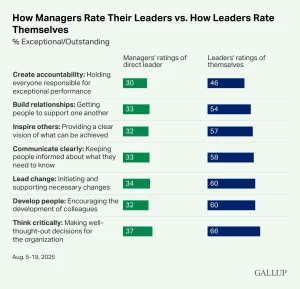
There’s a disconnect there. In a 2025 Gallup survey, managers rated their leaders much lower on communication than the leaders rated themselves. No surprise there, perhaps, but the gap is considerable.
Among leaders, 58% said they were exceptional or outstanding in communication, which the poll defined as “keeping people informed about what they need to know.”
But just 33% of managers rated their leaders so highly, a gap of 25 percentage points.
What communicators need to do: When leaders meet, a communicator should be in the room, in person or on video, listening to the discussion, taking notes and then recasting the message so managers can get the most from it.
Communicators tell us this takes too much time and delays the timeliness of the messaging, but this isn’t a nice-to-have add on. Communicators are reporters. They should be able to turn around the messaging quickly, hopefully no later than the next day. And leaders have to trust them to do it well, without multiple rounds of approvals.
2. Pass it on. Managers are expected to scoop up the information, or as much as they can gather, and deliver it to their teams. How they do that is the issue. Even when provided with a newsletter and a directive to share it directly, managers are inconsistent.
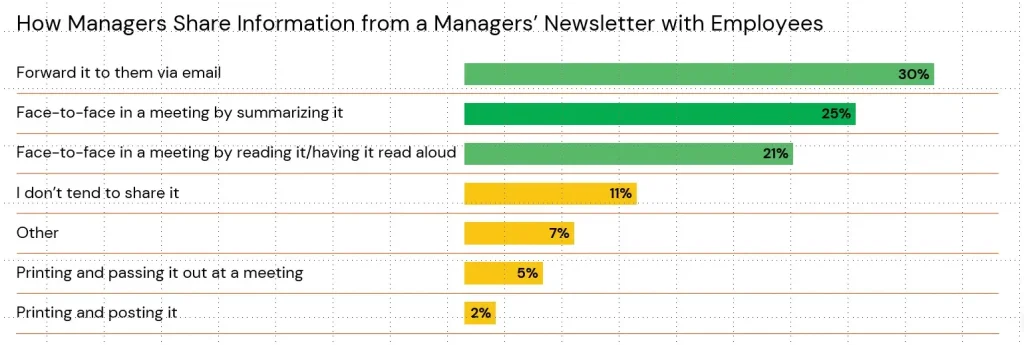
In a survey of managers from one of our audits, only 25% said they summarize the information in a face-to-face meeting, the preferred method.
The largest group of managers, 30%. said they merely forward the newsletter to their teams, while 21% said the the newsletter is read aloud during a meeting. Another 11% admitted they tend not to share the information.
What communicators need to do: Simplify. Managers say they get too much information to communicate and can’t fit it all into a team meeting, even after communicators fine tune it. Communicators can help by:
- Separating what managers need to understand from what employees need to do.
- Training the managers in the art of delivering succinct messages in a short window.
We once designed a huddle meeting for managers at a call center. Those employees were required to be on the phone all the time; in fact, they were graded by how many calls they handled. But at every shift change, managers held a stand-up meeting, and we gave them seven minutes of material to convey this way:
- Operations. In three minutes, managers address any issues with running the call center: technical issues they might encounter, specific questions callers were raising (and how to handle them), and anything else they need to know about the upcoming shift.
- Employee comms. Then, in two minutes, managers relay specific internal communications, such as HR deadlines, employee surveys, upcoming events and other timely, need-to-know information.
- Feedback. In the final two minutes, managers ask for any questions or concerns from the employees. What don’t they understand? What don’t they agree with? What should the managers take back to the leaders?
If managers can learn how to update their teams in seven minutes, imagine what they can do in a more-typical staff meeting.
3. Send feedback up the chain. Managers can be good listeners, but they have rare opportunities to discuss what they’ve learned with the top brass. Here’s what we’ve recommended to leaders:
- Demand accountability. The only way leaders can tell if managers are cascading anything is to ask them.
- Build in time. In leadership meetings, to allow a communicator to report on what the front lines don’t fully understand.
Managers under siege
Managers have something else to worry about: being replaced by AI. The tech companies are out in front on this. In a letter to staff announcing layoffs at cryptocurrency trading platform Coinbase, CEO Brian Armstrong cited the need for the company to be “leaner, faster and more efficient,” with no “pure managers.”
“Every leader at Coinbase must also be a strong and active individual contributor,” Armstrong wrote. “Managers should be like player-coaches, getting their hands dirty alongside their teams.”
Another trend is to just reduce the number of managers, leaving the surviving managers to supervise more people. These “megamanagers,” have less time to help their teams solve problems, dole out compliments, or show appreciation, Allison Vaillancourt, an executive at HR benefits-consulting firm Segal, told Business Insider.
“When people don’t feel valued, they either start thinking about leaving or doing just enough to keep their jobs,” she said.
Sounds like more work for managers—and less time for guiding their teams.
Is your cascade really cascading — or just trickling? Jim Ylisela, senior partner at Ragan Consulting Group, can help you find out what’s getting in the way ― and how to fix it. Email Jim to set up a free call.
Follow RCG on LinkedIn and subscribe to our weekly newsletter here.